DEMOK.eu - system for scoring politicians and public projects online - Direct Democracy Foundation
DEMOK.eu - system for scoring politicians and public projects online - Direct Democracy Foundation
Opis
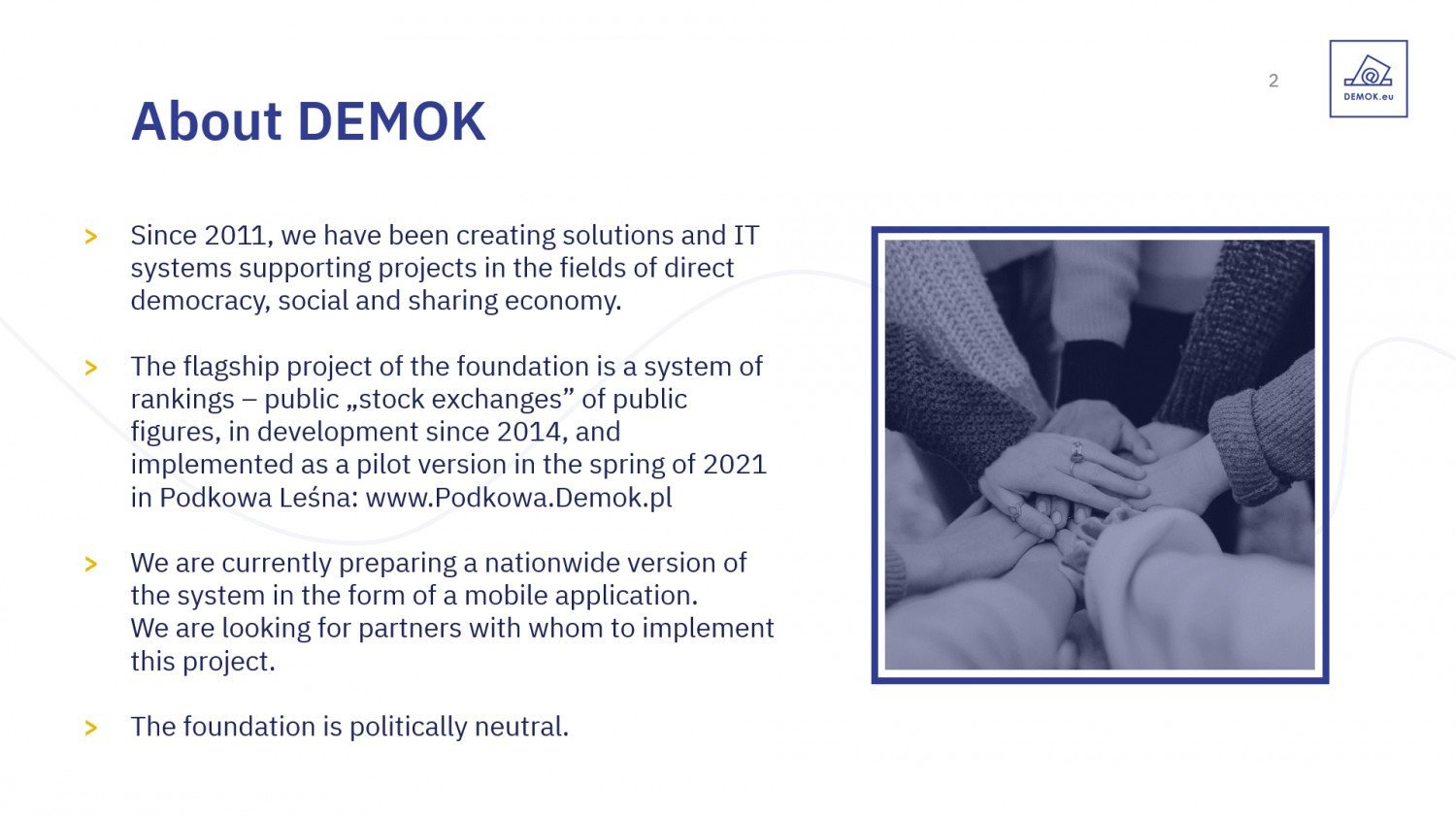
DEMOK.pl – online direct democracy, including social rankings,
rating politician’s ideas and actions, and state’s needs.
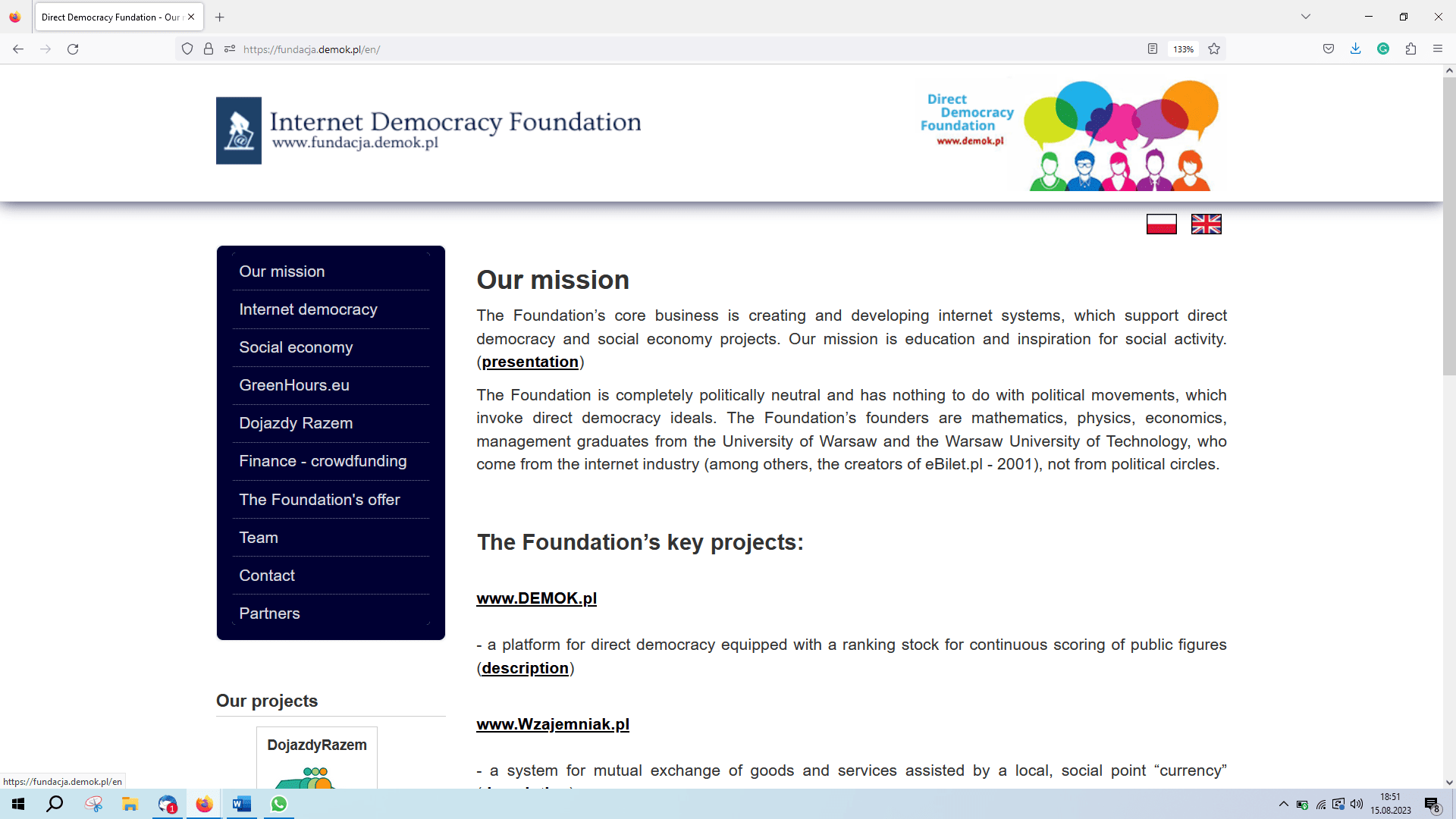
www.fundacja.demok.pl/en/
Do you want to have a real and direct impact on what is happening in the country?
Help us to continue the DEMOK.pl project!
The goal of our project is to launch a system (web + mobile application) for daily evaluation of the work of politicians and important public projects. The system is modeled on the stock market. The idea is extremely simple - each user will be able to rate any of the national or EU politicians using 10 standardized criteria, awarding from 0 to 10 points within each criterion (that is, from 0 to 100 points in total). We can modify such ratings over time if our assessment of any politician changes. The first version of the system can be viewed at: www.demok.pl, where it functions in a local version intended for Podkowa Leśna residents.
What will the system do with our ratings?
Each day it will draw an average of the ratings given by all users to a given politician and publish such an arithmetic average as the "value" - the public rating - of that politician for the day. This will create a ranking that can change every day. Politicians will be rated on an ongoing basis, every day, not just on the occasion of elections. What is important, we are evaluating specific individuals, not parties or their programs.
We believe that through such a mechanism it will be possible to raise the political culture in EU over time.
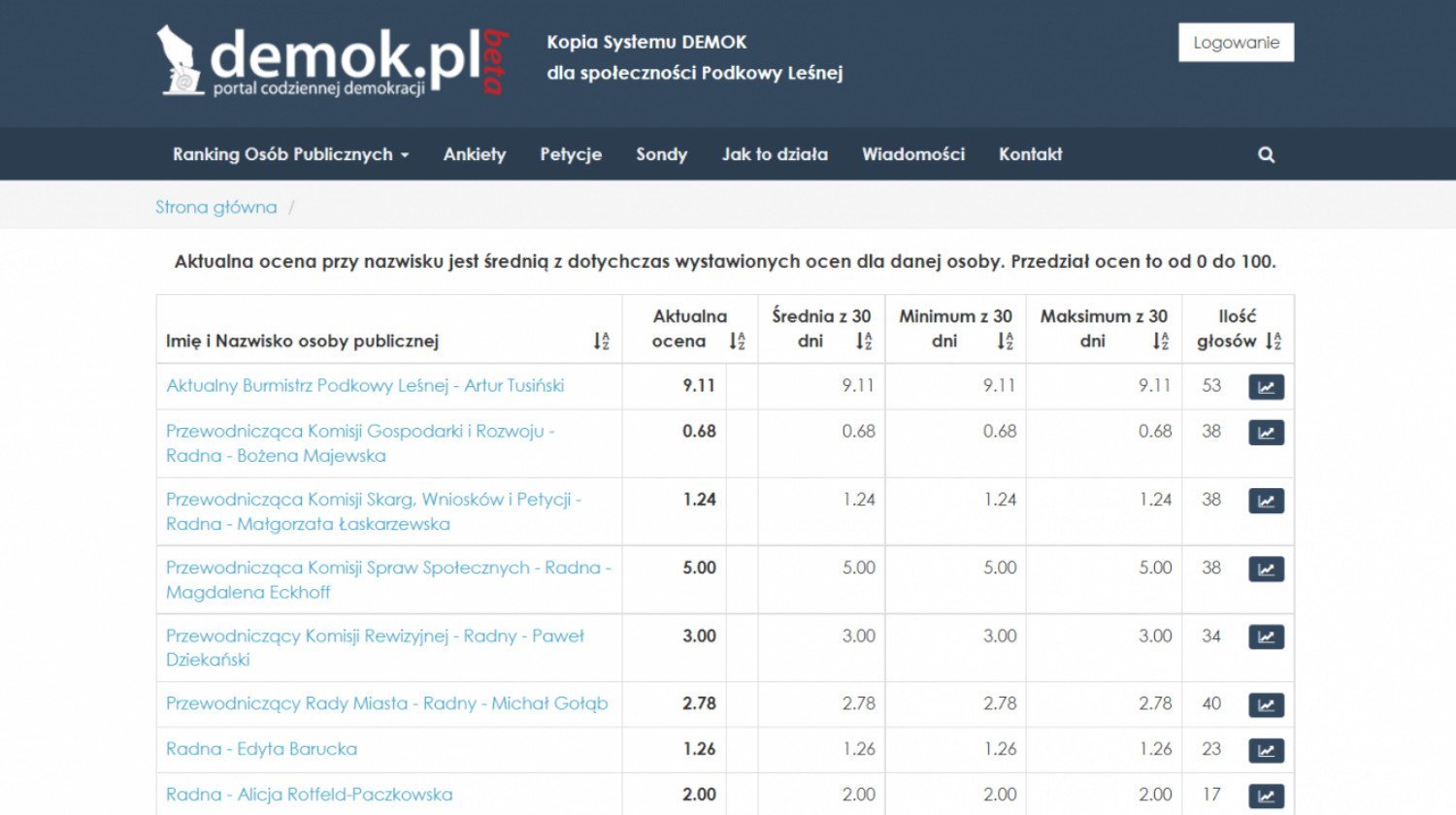
In the summer of 2021, our foundation (www.fundacja.demok.pl) conducted a microscale test of this system, providing Podkowa Leśna residents with a tool for surveys, petitions and evaluating officials and councilors. Residents used it to judge councilors and the local mayor: https://podkowa.demok.pl/rankingi-lista-wynikow
The experiment can be considered successful and is now worth running nationwide.
This is also what our collection serves.
The overall goal of the Direct Democracy Portal is to democratically evaluate optimal solutions to social, economic and political problems, taking into account the voices of authorities in the relevant fields.
The project aims to enable any willing citizen to DIRECTLY score any publicly important issues and those responsible for the functioning of the republic and its public space.
We wish to constantly collect, in an orderly manner, the opinions of Poles on all important social, economic and political issues. The portal is intended to enable precise articulation of the expectations that taxpayers and citizens have of "the authorities" in return for the money entrusted to the government and state institutions (taxes).
It is also hoped that, in the long term, the Portal will improve relations between the State, its administration and the "ordinary citizen", and contribute to raising the political culture. The Portal is also intended to be an expression of respect for the contribution of each citizen to the financial maintenance of the common State.
Regards, Piotr Krupa Lubanski
+48 511 423 975
www.demok.eu
MORE about the project ...
We all give half of our earnings to the state in taxes.
In theory, these are the funds to support the state. Half of our income. Half of our working time. Half of our professional life. It seems to be a lot. So here comes a very simple question. Shouldn’t a citizen have a say in deciding what happens with their money? Or to rate those who manage the money, that is the politicians? Voting every four 4-5 years for barely known candidates, randomly allocated to electoral districts, is not much of a right to vote.
It is a problem present in every country and that’s why the idea of direct democracy is so popular in Europe. For this reason, one of the main goals of the DEMOK foundation is a creation of online tools supporting direct democracy processes and allowing every
citizen to directly participate in state’s affairs.
Political stock exchange
One of DEMOK’s first projects was a system allowing the residents of Podkowa Leśna to anonymously vote in surveys and petitions, and to rate local councilmen and mayor. Resident’s evaluation is presented in a form of a ranking with marks between 0 and
100 points. It is the most interesting feature of the system. It resembles a stock exchange, but instead of stock quotes of companies, those of councilmen or politicians are presented.
How does it work? There are 10 criteria predefined in the system used to evaluate public figures. Specifying those criteria and their weights requires further discussion, given that some characteristics might be more important than others. Here are examples
of said criteria: fulfilling promises, level of education, good manners, life accomplishments, separating public and personal affairs, engagement in public service and finally one’s subjective rating of the public figure and a level of willingness to support them.
In every category a public figure can receive from 0 to 10 points which means they can get from 0 to 100 points in total from each evaluator. Such values were chosen so that everyone can easily calculate the percentage which shows how highly supported a
given politician is. Thanks to that feature, everyone can rate any politician (including historical figures), and not only those from one’s electoral district.
The evaluation can take place every day and not once in four years, and it can be changed – the system will remember the previous amount of points attributed to any given person but only the last rating will be taken into consideration.
Around 3 am every day, the system sums up all votes from the previous 24 hours, calculates the average rating of a given politician and publishes their current value. Such rankings can motivate or keep the politicians in check, if they are regularly quoted
by the media. Every time a politician does something right, their ‘market value’ will increase the next day and if they say something stupid or vote against their promises, they can be sure that they will go down in the ranking. The mechanism is very similar
to that of a stock exchange – every good news about a company increases its value, every bad one decreases it.
Every citizen will get an opportunity to directly evaluate every public figure in the country. Maybe their individual rating won’t be clearly visible but it will still be taken into consideration when calculating the average. The system will also give a possibility
to observe how the rankings change in time and whether the changes correlated with important events.
Personal engagement instead of statistics Apart from politicians, it will be possible to rate the projects conducted by the state or
projects which should be undertaken. Such rankings are continuous and can show how the opinions about a given subject change. System founders do not aim to create another statistical tool or to replace market surveys, but to design a tool which
will allow every interested person to state their opinion.
But who will become a user of such a platform? There have been many remarks stating that probably only certain people will be interested in participating in the project – those already politically active, political science students, journalists etc. Or that the
platform will be dominated by a certain political option which could mean that the rankings won’t be representative of the whole society.
Delegating voting rights – online parliamentary representative:
To activate the greatest number of citizens, we decided, a bit paradoxically, to create a mechanism in our system which allows representative democracy, meaning that at first more politically active people would join in order to draw in the rest of the community.
An active user can ask their friends or family, who are not involved in the political or social actions, to set up their accounts in order to delegate their voting rights and their capacity to evaluate to the active user.
In this way, the active user can become a representative of their family or group of friends. And in view of how big a list of facebook friends can be, it should be fairly easy to convince more and more people to create accounts.
Each vote made by the activist will then have the weight equal to the number of people who temporarily delegated their right to vote to the activist. Acting as a representative for a group might be a very motivating factor. Thanks to social media, the group of
people on behalf of whom such a representative votes can be quite numerous. Therefore the platform can become a way to train people to be more politically active, or even a place which gives a start to estimable political careers.
As project creators we hope that the people delegating their voting rights to activists will soon decide to vote for themselves and thus they will increase the number of active users and at the same time the number of citizens involved in social and political issues.
Democracy based on experts’ opinions.
The feature of delegating voting rights can be turned on when required, and enables users to delegate their voting rights in surveys concerning fields in which users are not specialists. If the user is not well acquainted with issues regarding health service or
national defence, they can give their voting right (also temporarily) to the expert who they deem trustworthy as long as that person also sets up an account in the DEMOK system. This is again a representative democracy, but here we have a division into the
fields of expertise because people should handle and decide on matters with which they are familiar.
Landscape of society. We also hope that even if the users want to stay anonymous, they will be willing to disclose some basic information about themselves (such as age, education, area of residence, maybe their career or political views).
These data would permit to analyse voting patterns for different social matters, projects and politicians with regard to said data.
Online surveys can be everlasting. When analysing voting patterns, timeline can also be taken into consideration. The possibility to change a vote or to re-evaluate a politician is an important detail. Online surveys can be long-lasting, which allows new people to join at any time as well as lets those who have already voted to change their decision.
Such surveys can be presented on timelines, clearly showing the ranking’s fluctuation, which in itself can be an interesting data to analyse.
Weighted voting system – a tribal-style democracy. The system presents many more opportunities for research. For example, an experiment about “weighted democracy” could be conducted to see what would be a result of a survey if users’ votes had different
weights, depending on, for example, age, education, taxes paid, number of children etc.
In today’s democracy, every vote is equally important, no matter the person’s life experiences. A professor of economy or an experienced entrepreneur’s votes are equal to the vote of a person with little knowledge in social and political matters. However,
this rule, which makes everyone’s voting rights equally valuable and which shows respect to every human being, has not always been the obvious solution.
Humans have been living in more primal social structures, such as tribes, for hundreds of thousands of years. In such societies, although decisions were made collectively; they were voted only by tribal elders, often with a shaman or a chief as a central figure,
and not by the whole group. The young could follow the discussions but were not allowed to participate in the decision making process itself. If everyone has the same voting power, no matter their experience or knowledge, there is a risk that the voices
and votes of those who better understand certain issues will be lost in the sea of voices and votes of those less competent. Such a voting method makes the decision making process seem more random than informed. There is a slim chance of making a good
decision in such a way, unless the specialist in a given field is able to convince others to vote like them.
It has to be stressed that this feature would be only experimental. Weighted votes are a subject that would surely become a social controversy, even though in the oldest and longest-lasting forms of human societies, that is in tribal structures (and later in families
or clans), the voting power was never equal.
Risks of online democracy. A democracy based on online systems can be much more efficient, faster, cheaper, and most importantly continuous. An official referendum can cost from tens to hundreds of thousands PLN and its organization can last up to several months.
An online referendum or a survey can be organized within a few days and cost a few hundred euro, maybe even less. Safe online voting requires confidentiality and anonymous profiles but with real people behind them.
There is a risk of technical manipulations (for example as a result of hacking) as well as a public concern about such events taking place. To prevent that, a supervisory board could be established to make sure the system is operating safely and correctly.
Blockchain could provide a solution for these concerns, as it, by its very nature, makes vote manipulation impossible and at the same time it requires no centralized supervisory institutions. Such solutions are already being implemented to serve democracy in many
countries, including Lithuania.
Education. How can we avoid the negative consequences of equal voting rights in today’s democracy? The only way is probably to educate the society. Only a well-informed, resistant to manipulation person can make good decisions and, most importantly,
choose good representatives. And that could be the main contribution of the DEMOK project to democracy – rankings of politicians which can help choose those who are worth of society’s backing and can be trusted with public functions.
Educating and inspiring to actively participate in social and political life is a main goal
of this project. Every survey or petition will be accompanied by an educational dossier,
including reports and analysis, to help users better understand the topic before they vote.
Raising social awareness in the main mission of the Direct Democracy Foundation.
We firmly believe that our online systems can serve that purpose by providing people
with a fun way to become more politically active.
We encourage you to suport us.
Piotr Krupa – Lubański, tel +48 511 423 975
https://www.linkedin.com/in/startuphub/
www.Podkowa.Demok.pl
www.fundacja.demok.pl/en/